
Bengaluru Real Estate Market 2026: September Signals Point to Selective Demand, Premiumisation and Infrastructure-Led Growth
Bengaluru’s real estate market in 2026 is seeing selective growth, driven by employment, infrastructure and premium housing demand. Rising prices are making buyers more cautious, while established developers and well-connected locations continue attracting interest. North and South Bengaluru, Whitefield, Sarjapur Road and Yelahanka remain key growth corridors.
Bengaluru’s real estate market is entering the final quarter of 2026 with a more selective form of growth. September trends indicate that property demand remains firmly anchored in the city’s employment engine, infrastructure expansion and premium housing appetite, although rising prices are making buyers more cautious. Rather than disappearing, demand is increasingly concentrating around projects, locations and developers that offer stronger connectivity, quality and long-term value.
The first half of 2026 established a relatively resilient foundation for Bengaluru property demand. According to Knight Frank data reported in July, the city recorded 27,968 residential sales during H1 2026, a 5% year-on-year increase. New launches reached 34,749 units, while average residential prices climbed 9% to ₹9,354 per sq ft. At the same time, unsold inventory increased to 74,299 units, suggesting that the market is expanding but buyers are becoming more discerning about what they purchase.
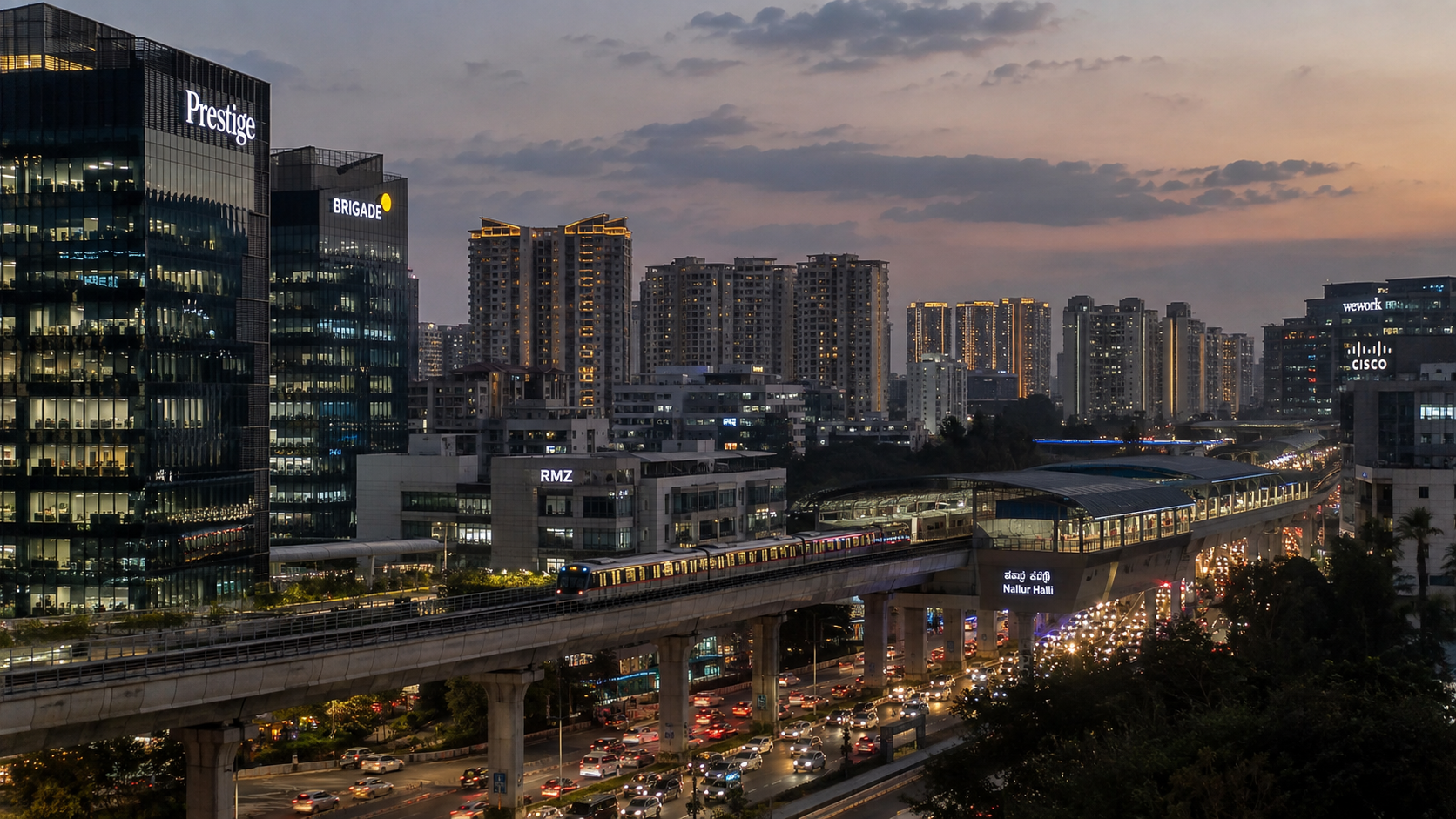
September developments reinforce this shift towards premiumisation. JLL reported that Bengaluru’s residential sales declined 6% quarter-on-quarter in Q2 2026 to approximately 17,000 units, with higher property values and greater premium-segment supply influencing affordability. Yet established developers continued to attract significant interest, with their new projects accounting for around 25–30% of quarterly sales. This suggests that credibility, construction quality and product positioning are becoming increasingly important in the Bengaluru housing market.
The premium housing segment is consequently becoming one of the defining features of Bengaluru real estate in 2026. Knight Frank data showed particularly strong growth in the ₹2 crore–₹5 crore segment, where launches increased 50% year-on-year during H1. Meanwhile, September reporting from ANAROCK indicates that buyers are showing greater interest in larger homes, premium properties, new launches, established developers and future resale or rental potential.
Location remains another decisive factor shaping property demand. South Bengaluru accounted for 36% of new launches and 34% of sales during H1 2026, according to Knight Frank data cited in September reporting. Meanwhile, North Bengaluru continues to attract major development activity around the Hebbal–Devanahalli corridor, while Whitefield, Sarjapur Road and Yelahanka are benefiting from the city’s outward expansion. These corridors are increasingly being shaped by the combination of employment centres, transport connectivity and new residential supply.
Infrastructure is also becoming increasingly important to the Bengaluru property market outlook. The proposed expansion of the Namma Metro network is strengthening the long-term case for several emerging residential corridors. In September, the first elevated section of the Pink Line was expected to open, connecting Kalena Agrahara with Tavarekere and improving access to locations including Hulimavu, JP Nagar and the IIM Bengaluru area. Once operational, Bengaluru’s metro network is expected to cross the 100-kilometre mark.
Employment remains the underlying engine. Bengaluru continues to dominate India’s Global Capability Centre ecosystem, with JLL reporting more than 900 GCC units and a 34–39% share of national GCC activity. Fresh corporate commitments are also continuing; Booking.com, for example, recently leased more than 111,000 sq ft at RMZ Ecoworld, highlighting continuing corporate demand for Bengaluru’s office ecosystem. Such employment activity supports both home ownership and rental demand across established and emerging residential corridors.
September’s market signals therefore point towards a Bengaluru real estate market that is not simply expanding, but becoming more sophisticated. Rising prices, larger-ticket housing and increasing inventory mean buyers have greater reason to compare projects care.