
Northward Bound
Why Bengaluru’s Developers Are Betting Big on the City’s Next Growth Frontier
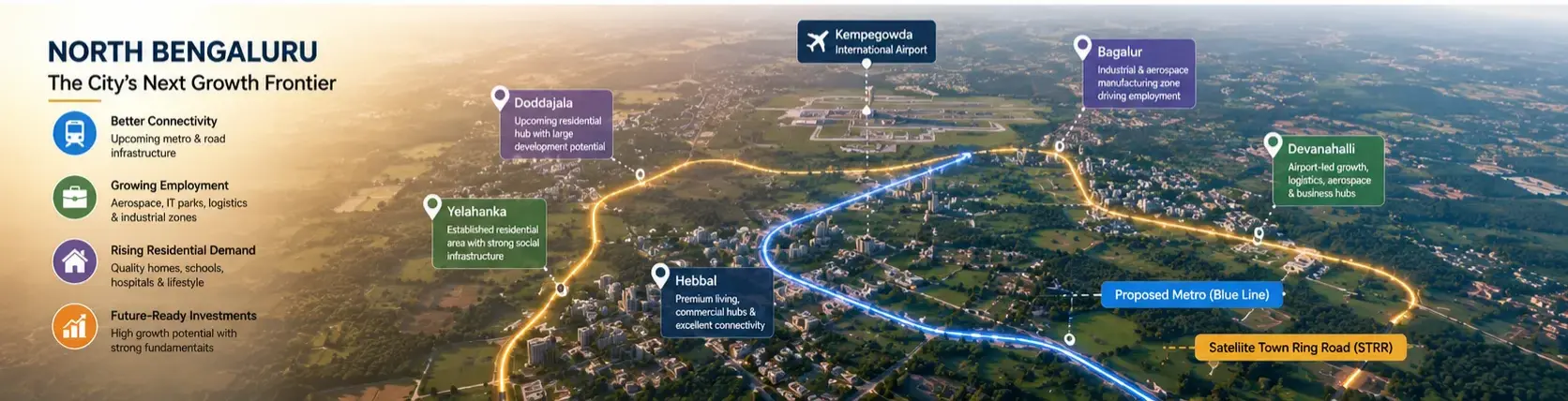
Bengaluru’s property market is entering a new phase, and the direction of travel is increasingly clear: northwards. For years, the city’s strongest residential stories were built around established corridors such as Whitefield, Sarjapur Road, Koramangala and Electronic City. Today, however, developers are looking beyond Bengaluru’s traditional urban boundaries. From Hebbal and Yelahanka to Bagalur, Doddajala and Devanahalli, North Bengaluru is emerging as one of India’s most closely watched real estate corridors.
This is not simply a land-bank story. Developers are moving north because infrastructure, employment, connectivity and changing buyer preferences are beginning to converge in the same geography. The latest market data underlines the scale of the shift. JLL’s Q2 2026 Bengaluru residential assessment identifies the Hebbal–Devanahalli corridor as the city’s primary hub for new Grade-A office and residential development. It also notes that residential growth is increasingly moving towards Yelahanka and other northern locations as established parts of the city become more constrained.
The broader Bengaluru market remains remarkably resilient despite a more cautious second quarter. JLL recorded around 17,000 housing sales in Q2 2026, while average property prices increased 3.1% quarter-on-quarter. Although launches fell 20% from the previous quarter as developers adopted a more measured approach, Bellary Road remained the leading location for new supply. For developers, that makes North Bengaluru more than another emerging suburb. It is becoming a strategic expansion market.
The Airport Has Changed the Geography of Growth
The biggest structural advantage of North Bengaluru is Kempegowda International Airport. Airports rarely remain isolated transport facilities. Once surrounded by business parks, logistics operations, hotels, warehouses, aerospace companies and supporting services, they can create entirely new economic districts. Bengaluru is increasingly following this pattern.
Devanahalli and the surrounding northern corridor are benefiting from the gradual emergence of an airport-led business ecosystem. The combination of aviation, logistics, hospitality, industrial activity and commercial development is creating demand for housing close to employment. That matters enormously to residential developers.
A successful housing project is no longer judged only by its distance from Bengaluru’s city centre. Buyers increasingly want a practical relationship between home, workplace, airport, schools, healthcare and major transport networks. North Bengaluru can offer that combination at a scale that many mature central neighbourhoods cannot. The result is a shift from speculative peripheral development towards what could eventually become a genuinely integrated urban corridor.
Infrastructure Is Becoming the Real Estate Catalyst
Infrastructure has always influenced Bengaluru property prices, but North Bengaluru offers an unusually concentrated pipeline of major projects. The proposed and developing Namma Metro connectivity to Kempegowda International Airport is perhaps the most significant. In August 2026, Karnataka authorities said the 58-kilometre Blue Line connecting Bengaluru with the airport is expected to become operational within two years.
The timing remains subject to construction and commissioning realities, and Bengaluru’s wider Blue Line programme has already faced delays. The uncertainty is important: developers cannot simply price future infrastructure as though it were already operational. Yet the long-term effect is difficult to ignore.
Better public transport changes how people perceive distance. A location that feels remote when dependent on road travel can become considerably more attractive once reliable mass transit arrives. Road infrastructure is adding another layer. The Satellite Town Ring Road is designed to improve connections between Bengaluru’s peripheral economic centres, while northern road improvements are expected to strengthen links between the airport, industrial zones and established parts of the city.
For developers, infrastructure creates something particularly valuable: confidence that a project launched today can become more accessible as it matures.
Employment Is Following the Infrastructure
Residential growth cannot survive on connectivity alone. People need reasons to live in a particular location. This is where North Bengaluru’s industrial and commercial transformation becomes important. The region around Devanahalli and Bagalur has attracted attention from aerospace, defence, logistics and technology-related businesses. Karnataka is also continuing efforts to develop its aerospace and defence ecosystem in the region. In June 2026, the state moved towards a voluntary land-purchase model for the Aerospace and Defence Park, with a proposed compensation package of ₹2.70 crore per acre.
Such investments can have a multiplier effect. Factories and business parks create direct employment. Those employees require homes. Businesses require suppliers, hotels, restaurants, schools, healthcare services and transport. Over time, these activities create a local economy rather than merely an extension of Bengaluru's housing market.
This is one of the strongest reasons developers are looking north. The opportunity is no longer based solely on selling homes to people who commute into central Bengaluru. The longer-term proposition is to build communities around emerging employment centres.
Developers Are Chasing Scale
Another powerful attraction is land. Central Bengaluru has become increasingly difficult and expensive for large-scale development. Fragmented land parcels, high acquisition costs, established neighbourhoods and infrastructure limitations make sizeable projects harder to assemble.
North Bengaluru offers developers something increasingly scarce elsewhere: larger development opportunities. That allows them to build townships, gated communities and mixed-use developments with extensive amenities. Rather than constructing isolated apartment blocks, developers can create entire residential ecosystems with retail, leisure, education and community facilities.
The market is already showing this change. Cushman & Wakefield reported 12,664 new residential units launched across Bengaluru in Q1 2026, with East and North Bengaluru driving much of the activity. More recent market reporting indicates that North Bengaluru accounted for around 29% of Bengaluru’s launches and 31% of sales in H1 2026, while launches and sales in the northern corridor increased 10% and 11% respectively year-on-year. Those figures are particularly significant because they demonstrate that developers are not merely releasing more inventory in the north. Buyers are absorbing it as well.
The Premiumisation of North Bengaluru
Perhaps the most interesting change is the type of housing being developed. North Bengaluru is no longer positioned purely as an affordable alternative to established areas. Premium and luxury projects are increasingly becoming part of the corridor’s identity.
Bengaluru’s wider housing market is experiencing a strong premiumisation trend. JLL reported that rising property values, larger homes, premium launches and strong employment from Global Capability Centres are reshaping demand. Knight Frank’s 2026 market data similarly shows that Bengaluru’s residential market has been supported by strong demand for higher-value housing, with average prices continuing to rise. This is changing the developer proposition in the north.
Instead of competing primarily on price, builders can now sell space, amenities, exclusivity and future connectivity. Large apartments, landscaped communities, clubhouses and premium lifestyle facilities are increasingly appearing in the corridor. That is particularly attractive to Bengaluru’s affluent technology and corporate workforce, many of whom are willing to travel further for larger homes and better planned communities.
But North Bengaluru Is Not Without Risks
The enthusiasm surrounding the northern corridor should not obscure its challenges. Infrastructure announcements do not automatically translate into completed projects. Metro delays remain a reminder that property buyers and developers must distinguish between promised connectivity and operational connectivity. Recent reports have indicated that sections of Bengaluru’s Blue Line have slipped towards 2027, demonstrating the uncertainty surrounding major infrastructure timelines.
There are also concerns around water availability, last-mile connectivity and the uneven pace of social infrastructure development across the northern fringe. The further a project moves away from established neighbourhoods, the more important schools, hospitals, retail and everyday services become. Developers therefore face a new challenge. It is no longer enough to acquire cheap land and build apartments. The winning projects are likely to be those capable of creating functioning communities.
A New Chapter for Bengaluru Real Estate
The movement towards North Bengaluru represents a deeper transformation in the city’s property market. Developers are responding to a combination of expensive land in established markets, demand for larger homes, airport-led economic growth, expanding employment clusters and a growing infrastructure network.
The numbers suggest that the transition is already underway. North Bengaluru is gaining market share, attracting premium development and increasingly connecting residential demand with commercial and industrial expansion. The next decade could therefore see Bengaluru develop not as a city with one dominant centre, but as a network of interconnected economic corridors. North Bengaluru sits at the heart of that transformation.
For developers, the opportunity is substantial. For buyers, however, the lesson is more nuanced. The strongest opportunities are unlikely to be determined simply by how close a project is to the airport. They will depend on the quality of infrastructure, employment connectivity, social amenities, developer credibility and the ability of each micro-market to evolve into a self-sustaining urban community. North Bengaluru is moving from the edge of the city towards its economic centre of gravity. And for India’s technology capital, that could prove to be one of the most important real estate shifts of the decade.